
ESTÉ HOMES

Real Estate Brokerage in Switzerland: Commissions, Fees and How It Works

When selling a property in Switzerland, several questions frequently arise: Who pays the real estate agent’s commission? How much does a real estate agent charge? Who pays the notary fees? Which costs are paid by the seller and which by the buyer?


In Switzerland, practices may vary depending on the canton, the value and location of the property, and the terms of the brokerage agreement.

In French-speaking Switzerland, and particularly in the canton of Vaud, the real estate agent’s commission is generally paid by the seller, while the buyer is primarily responsible for the costs associated with the acquisition.

Here is an overview of how a real estate transaction works and how the main costs are typically divided between buyer and seller.

Who pays the real estate agent’s commission in Switzerland?

In French-speaking Switzerland, the real estate agent’s commission is generally paid by the seller when the seller has appointed an agent or real estate agency to market the property.

The terms of the agent’s remuneration are defined in the brokerage agreement between the property owner and the real estate professional.

The commission is generally calculated as a percentage of the final sale price and becomes payable according to the terms agreed in the brokerage contract.

As practices may vary depending on the canton and the individual circumstances of the transaction, the terms of the brokerage agreement should always be reviewed carefully before the property is placed on the market.

How much does a real estate agent charge in French-speaking Switzerland?

There is no single fixed commission that applies to every real estate transaction in Switzerland.

In French-speaking Switzerland, real estate brokerage commissions can generally range from approximately 3% to 5% of the sale price, depending on factors such as:

  • the value of the property;
  • its location;
  • the type of property;
  • the complexity of the sale;
  • the services included in the brokerage agreement;
  • the marketing strategy required.

In certain resort markets or for properties requiring a specific sales strategy, commissions closer to 5% may be applied.

For higher-value properties, development sites or investment properties, the fee structure may also be adapted or calculated on a sliding scale.

Example: sale of a property for CHF 1,000,000

With a brokerage commission of 3%, the fee would amount to:

CHF 1,000,000 × 3% = CHF 30,000

However, the percentage of commission should not be considered in isolation.

An appropriate sales strategy, an accurate valuation and effective negotiation can have a significant impact on the final result achieved for the property owner.

Who pays what in a real estate transaction in the canton of Vaud?

The costs of a property transaction are not divided equally between the seller and the buyer.

Costs generally paid by the seller

Real estate brokerage commission

When the seller appoints a real estate agent, the commission agreed in the brokerage agreement is generally paid by the seller.

Real estate capital gains tax

When a taxable capital gain is realised on the sale of a property, the seller may be liable for real estate capital gains tax.

The amount depends on several factors, including the taxable gain and the length of time the property has been owned.

Potential mortgage early-repayment penalty

If the owner terminates or repays a fixed-rate mortgage before the end of its agreed term as a result of the sale, the bank may charge an early-repayment penalty, depending on the mortgage agreement.

Other potential costs related to the sale

Depending on the property and the transaction, additional costs may arise for documents, technical specialists or other services required to prepare the property for sale.

Costs generally paid by the buyer

The purchase price

This is, of course, the principal cost of acquiring the property.

Property transfer tax

In the canton of Vaud, the acquisition of real estate is subject to property transfer tax.

Notary fees and costs

A real estate transaction must be executed in the legally required authenticated form. The notary prepares the deed and plays a central role in the legal transfer of ownership.

Land Registry fees

The transfer of ownership must be registered with the Land Registry.

Potential financing costs

Creating or modifying a mortgage certificate (cédule hypothécaire) and certain other aspects of mortgage financing may also generate additional costs.

How much should a buyer budget for acquisition costs in the canton of Vaud?

As a general guideline, a buyer can often budget approximately 5% of the purchase price for the overall costs associated with acquiring a property, depending on the transaction.

It is important to understand that these are not simply “5% notary fees”.

This overall amount can include several separate costs, such as property transfer tax, Land Registry fees, notary fees and expenses and, depending on the circumstances, certain financing-related costs.

The exact amount should always be calculated for the individual transaction. 

Who pays the notary fees when buying property in Switzerland?

In a typical real estate transaction in the canton of Vaud, the costs associated with the acquisition and the notarised deed are generally borne by the buyer.

The notary plays a central role in the transaction. The notary prepares the authenticated deed, ensures that the necessary legal requirements are met and enables the transfer of ownership to be registered with the Land Registry.

As practices and costs can vary from one canton to another, buyers should request a detailed estimate of the applicable acquisition costs for the property concerned.

What is included in a real estate agent’s commission?

A real estate agent’s commission does not simply cover publishing an advertisement and organising property viewings.

A complete real estate sales process involves several stages, many of which are not necessarily visible to the property owner.

1. Property valuation and analysis

The first step is to determine an appropriate market value for the property.

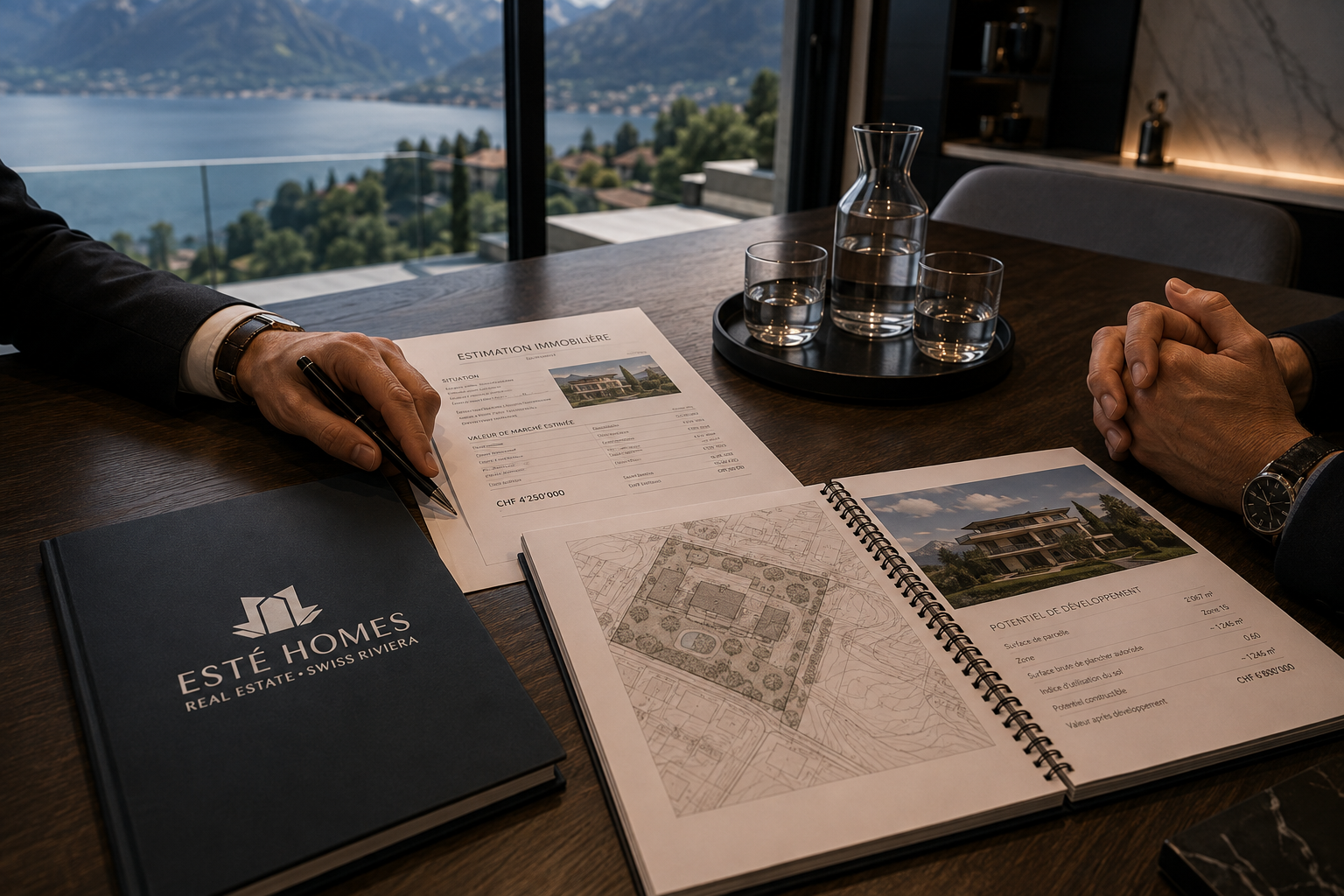
At ESTÉ HOMES, the initial property valuation is generally provided free of charge.

The objective is not simply to determine a price per square metre, but to understand the characteristics of the property, its location, the local market and the factors that may influence its value.

2. Analysis of the property’s potential

For certain properties, their current market value represents only part of their true potential.

This is particularly relevant for:

  • building plots;
  • older villas;
  • large plots of land;
  • investment properties;
  • properties that could potentially be extended or converted.

Depending on the project, we can analyse potential opportunities for extension, conversion or development.

Where necessary, architects, contractors or other specialists may also be involved to assess feasibility or estimate potential renovation costs.

This analysis can sometimes identify additional value that would not be revealed by a simple price-per-square-metre comparison.


3. Preparing the property for sale

Before a property is marketed, it is important to prepare complete and professional documentation.

Depending on the property, this preparation may include:

  • professional photography;
  • verification or measurement of floor areas;
  • collection of existing plans and documentation;
  • preparation of technical information;
  • creation of a professional sales brochure;
  • analysis of potential renovation works;
  • preparation of information required by buyers and their banks.

A well-prepared sales file also makes it easier to answer potential buyers’ questions and can facilitate their decision-making process.


4. Defining the marketing strategy

Not every property should be marketed in the same way.

At ESTÉ HOMES, certain properties may initially be presented confidentially and Off-Market, particularly to our network of private buyers and investors.

Depending on the results and the strategy agreed with the property owner, the marketing campaign may subsequently be expanded to property portals, social media and other distribution channels.

The objective is to develop a strategy suited to the individual property rather than systematically applying the same sales process to every transaction.


5. Active prospecting and buyer search

This is probably one of the least visible aspects of a real estate agent’s work.

Publishing a property online does not mean simply waiting for a buyer to appear.

An active sales strategy may include:

  • contacting potential buyers directly;
  • approaching existing contacts within the network;
  • contacting investors when appropriate for the property;
  • responding to enquiries;
  • qualifying prospective buyers;
  • following up with interested parties;
  • communicating with banks or financial advisers where necessary.

A significant part of the brokerage process therefore takes place away from property portals and outside the actual viewings.


6. Viewings and negotiation

The real estate agent organises viewings, collects feedback from prospective buyers and manages discussions through to the submission of an offer.

Negotiation is an essential part of the process.

The agent’s role is not simply to forward an offer to the owner. It is also to represent and protect the seller’s interests, assess the strength of the prospective buyer and negotiate the different terms of the transaction.

Price is important, but it is not the only consideration. Financing, deadlines, conditions attached to an offer and the overall security of the transaction may also play an important role.


7. Support through to completion and handover

Once an offer has been accepted, the work does not stop.

The real estate agent assists the parties with the various stages leading to completion, including:

  • preparing the information required by the notary;
  • coordinating with the buyer;
  • following up on the buyer’s financing;
  • preparing for the signing of the deed;
  • coordinating the process through to the transfer of ownership;
  • handing over the keys.

The objective is to support the property owner from the initial valuation through to the successful completion of the transaction.


Is the real estate agent’s commission deductible from capital gains tax?

In the canton of Vaud, brokerage commissions and related fees that have actually been paid may, subject to the applicable tax rules, be taken into account when calculating the taxable real estate capital gain.

This means that the economic cost of a brokerage commission should not necessarily be considered solely on the basis of its gross amount.

Simplified example

A property owner sells a property and pays CHF 30,000 in brokerage commission.

Provided that the expense qualifies for tax purposes in the individual case, it may be taken into account when determining the taxable real estate capital gain.

The actual tax impact depends on several factors, including:

  • the length of ownership;
  • the original acquisition price;
  • the sale price;
  • qualifying investments and renovation works;
  • other deductible expenses;
  • the applicable tax rate.

It would therefore be incorrect to state that a 3% commission ultimately “costs” a specific lower percentage after tax.

Each situation should be assessed individually.

In certain circumstances, an early-repayment penalty paid to a bank following the termination of mortgage financing in connection with the sale may also be taken into consideration for tax purposes, subject to the applicable rules.

Contact us

    Selling privately or using a real estate agent: what is the difference?

    It is perfectly possible to sell a property in Switzerland without using a real estate agent.

    The most obvious advantage is that the owner does not pay a brokerage commission.

    However, the comparison should not be based solely on the amount of the commission.

    The more important question is:

    What will be the final outcome of the sale?

    An owner selling privately must generally manage the entire process, including:

    • determining the asking price;
    • preparing the sales documentation;
    • marketing the property;
    • responding to enquiries;
    • qualifying potential buyers;
    • organising viewings;
    • following up with interested parties;
    • negotiating offers;
    • coordinating the different stages of the transaction.

    After 10, 15 or 20 viewings, repeated objections and several rounds of negotiation, it can also become more difficult for an owner to maintain the same distance from the transaction.

    Selling your own property naturally involves an emotional element.

    A real estate agent also acts as an intermediary during negotiations.

    An experienced agent is familiar with the arguments commonly raised by buyers, can assess objections in the context of the market and can negotiate the price and conditions without the same emotional involvement as the property owner.

    Using a real estate agent does not, of course, guarantee that a property will sell for a higher price.

    However, an experienced professional can provide a clear strategy, local market knowledge, access to a network of potential buyers, negotiation expertise and professional guidance throughout the transaction.

    At ESTÉ HOMES, our objective is therefore not simply to find a buyer.

    Our role is to understand the property, identify its potential and represent the owner’s interests throughout the entire transaction.

    Buying or selling property in Switzerland for the first time?

    The Swiss real estate transaction process can be difficult to understand, particularly for expatriates and people who have recently moved to Switzerland.

    Acquisition costs, mortgage financing, the role of the notary, residence permits and restrictions affecting certain property purchases can differ considerably from systems in other countries.

    ESTÉ HOMES assists property owners, investors and people relocating to Switzerland in understanding the different stages of a real estate transaction before making a decision.

    → Buying and Moving to Switzerland

    → Request a Property Valuation

    → Discuss Your Real Estate Project

    Compare Listings

    Title Price Status Type Area Purpose Bedrooms Bathrooms
    Estimez votre bien en 3 minutes